USPS Just Dropped A Bombshell, D’s Panic, Ballroom Is Much More Than You Know – Ep. 3976
Watch The X22 Report On Video

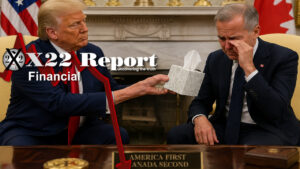

Carney is panicking, the is taking instructions from the [DS]/[CB] and pushed backed on the deal. He has no leverage and he fell right into Trump’s tramp. Soon Canada will fold. Trump is making beef affordable again. Trump is preparing the new system which will replace the [CB] system. Watch gold and Bitcoin. The [DS] is panicking because Trump is taking away the ability for the D’s to cheat in the election. They are trying to delay what Trump is doing with their corrupt judges but it is not working. USPS is following through on Trump’s orders to make sure those people that are receiving the ballots are citizens of the US. The ballroom is much more than you know. Why would the D’s be so concerned over a ballroom, because this is going to counter their insurgency.
Economy
Canada is strongest when we are united.
Today, I met virtually with the Premiers to discuss the suspension of trade negotiations with the United States and outline our next steps to protect our interests and support Canadian workers and businesses.
Read more:…
— Mark Carney (@MarkJCarney) August 22, 2026
One reason the Canada-US trade deal collapsed:
Canada could not promise / would not stop Chinese steel being transshipped into auto parts & then into the U.S. market.
The U.S. requires a strict “melt and pour” rule. Steel must be melted and poured in North America to qualify… pic.twitter.com/xQ8XTUpJhz
— Cecile Shaw (@CecileShaw) August 23, 2026
for preferential treatment. This stops Chinese steel from entering Canada, getting light processing, and crossing the border as “North American” content to evade tariffs. Recall The Canadian Steel Producers Association and Aluminium Association of Canada have both publicly confirmed Chinese dumping is happening, warning Canada risks becoming a dumping ground for China’s excess steel and aluminum. A recent White House report on the “transshipment scam” also listed Canada as a problem country in China’s shadow network for evading U.S. tariffs. Canada failed to deliver enforceable guarantees. Mexico accepted the melt-and-pour requirements, raised tariffs on Chinese steel and auto parts, and closed the back door. Canada left it open and the deal fell apart.
- You will note that “metals” are of keen interest to Canada. That is because Canada relies on imported metal product, rolled steel, aluminum ingots etc., as an outcome of their energy policy.
- Canada could not/would not promise to stop Chinese steel being transshipped into auto parts & then into the U.S. market. Why? Because the U.S. requires a strict “melt and pour” rule.
- Steel and aluminum must be melted and poured in North America to qualify for preferential treatment. This stops Chinese steel from entering Canada, getting light processing, and crossing the border as “North American” content to evade tariffs.
- Why is this a problem for Canada specifically (not Mexico)? Well, steel and aluminum cannot be made without coal and gas (heavy carbon emissions), because the core issue is heat (joules) for the melting. You cannot make molten metal from renewable energy, (ie. windmills and solar farms) you need massive heat (oil, gas, coal). It’s simple science, you need joules.
- Canada’s energy policy, climate change stuff, is about the creation of electricity and non-carbon emissions. They have decarbonized their industry, and as a consequence have disconnected their ability to melt metal. That’s why they import rolled steel and cast aluminum ingots from China.
- Their choice to decarbonize is exactly why Steel and Aluminum tariffs against Canada are structurally irreconcilable.
- ♦ So, what’s going to happen?
- . Think about it, if Canada refuses to reject ‘climate change’ and Canada refuses to accept tariffs, well, there is no option for a USMCA renewal.
- Trump is waiting for Canada to announce their retaliatory measures. It doesn’t make sense to wait until Canada announces retaliation and then just go up a notch from 50% to 75%, then they hit again and you go from 75% to 100% etc. etc.
- It just makes more sense to call it quits, make the announcement and withdraw completely from the USMCA. That would tell Carney the six-month clock is now ticking. Then go back and finish a bilateral agreement with Mexico.
- Eventually the reality will set in for Canada, and the collapse of the Canadian dollar (CAD) will begin as predicted by the Bank of Canada.
- As a consequence, when Canada crawls back to the table for their bilateral discussion, they will end up with the exact terms they just rejected.
Source: theconservativetreehouse.com
percent below current market prices. This deal will reduce prices for Americans while giving space for our Great American Beef Herd to grow again. Thank you for your attention to this matter! President DONALD J. TRUMP
We understand why beef prices are a problem right now. Ground beef is averaging $6.89 a pound, up 57% since 2021, and that's real pressure on American families.
But flooding the market with 300,000 metric tons of imported ground beef with no tariff for 90 days is not a solution… pic.twitter.com/G0seXBQnch
— Good Ranchers (@GoodRanchers) August 21, 2026
for American ranchers. It’s a short-term price fix that puts more downward pressure on the cattle producers who are already struggling to stay viable. Trump has not said which countries this beef is coming from or who committed to the 25% price reduction he’s promising. American cattle ranchers have been dealing with years of drought, high feed costs, and a shrinking herd. The answer to that is not more cheap imported beef with lower standards competing against them on shelves with no country of origin label required to tell you the difference. We will continue to source 100% American. That is not changin
American herds of cattle have shrunk to the smallest size in decades. The Biden administration regulations causes massive damage to our ability to produce beef in the USA.
This has lead to higher prices for consumers at the grocery store. President Trump has reversed the… pic.twitter.com/fOuCFqAjt6
— Wall Street Mav (@WallStreetMav) August 23, 2026
the Biden regulations, but it takes years to rebuild herd sizes. In the near term, the only way to bring down grocery store prices is to import beef from other countries. In our recent trade deals, President Trump has negotiated deals which open foreign markets to our American beef. President Trump is increasing the quota of beef that can be imported from Argentina to help lower prices for ground beef for Americans at the grocery store.
— Disclose.tv (@disclosetv) August 20, 2026
VP @JDVance: Manufacturing activity reached its best rate in years. We created more than 29,000 new jobs in the sector in 2026 so far, reversing years of decline in manufacturing employment. https://t.co/ggjl1yEd8m pic.twitter.com/CifKYfJaXF
— Trump War Room (@TrumpWarRoom) August 21, 2026
This could prove 100% accurate if he swaps ALL the Federal debt for T-Bills, then uses those T-Bills to back 0% yielding stablecoins, then cuts the rate on those T-Bills to 0.60% (b/c the banks don't deserve 3.5% on stablecoins).
You're gonna want to own more gold & BTC though. https://t.co/GucOX0rLVO
— Luke Gromen (@LukeGromen) August 20, 2026
1. Swap all federal debt into T-Bills
- Today the U.S. Treasury debt stock is a mix of short-term T-Bills, medium-term notes, and long-term bonds with different coupons.
- Converting (or refinancing) everything into T-Bills means the entire ~$36+ trillion debt becomes short-term paper that rolls over every few weeks or months.
- T-Bills normally carry the lowest interest rates on the curve (when the Fed keeps rates low). This already lowers the average interest rate the government pays compared with longer-dated debt.
2. Use those T-Bills to back 0%-yielding stablecoins
- Private stablecoin issuers (or a government-facilitated system) would hold the new T-Bills as reserves.
- The stablecoins themselves pay 0% to holders.
- Ordinary people, businesses, and institutions park cash in these stablecoins instead of bank deposits, money-market funds, or higher-yielding Treasuries.
- Result: the public is voluntarily (or via regulation/network effects) providing the government with funding at zero cost to the end holder.
3. Cut the interest rate the Treasury pays on those T-Bills to 0.60%
- Because the T-Bills are now the exclusive backing for a massive, captive demand for 0% stablecoins, the Treasury can (in this scenario) auction them at an artificially low yield—0.60%.
- Gromen’s parenthetical about “banks don’t deserve 3.5%” points to the current reality: banks and stablecoin issuers currently earn a nice spread by holding higher-yielding Treasuries or reserves while paying little or nothing to depositors/stablecoin holders. The plan eliminates that spread and captures it for the government.
Net effect on the deficitInterest expense is currently one of the largest (and fastest-growing) line items in the federal budget.
If you take the whole debt stock and drop the average rate paid from (say) 3–4% down to 0.60%, annual interest payments collapse by hundreds of billions of dollars. That directly reduces the fiscal deficit (spending minus revenue).
Once the deficit shrinks (or turns to surplus), the growth of the total debt slows or stops—hence “we have seen a peak in the fiscal deficit.”Important caveats (why Gromen still says “buy gold & BTC”)
In short: lower the interest rate the government pays on all its debt to near-zero by engineering captive demand via 0% stablecoins → interest expense plunges → deficit shrinks.
Contentious thesis.
My contentious thesis is that Bitcoin will eventually be valued like gold. It has perfect scarcity, decentralisation and transparent settlement: the neutral bearer asset for a digital financial system.
Bitcoin still trades at a market capitalisation…
— James E. Thorne (@DrJStrategy) August 21, 2026
significantly below Nvidia’s. Blockchain is the biggest record-keeping innovation since the Medici-era invention of double-entry bookkeeping. Wall Street has done no objective research, even as money and capital-market infrastructure migrates onto blockchain rails. Sec Bessent is moving forward with Genius Act. IMHO US will be the capital of innovation in the digital asset world. Team Warren may have won the battle but will eventually lose the war. We are so early in this theme. Have a great day.
Political/Rights
- A Biden-appointed federal judge has struck down the Trump administration’s suspension of immigrant visas for foreign nationals of 75 countries, handing immigration activists another victory against President Trump’s effort to slam the brakes on mass immigration.
🚨 A federal judge has struck down the Trump administration's suspension of immigrant visas for nationals of 75 countries, ruling the State Department policy violates federal immigration law and exceeds Secretary Marco Rubio's authority. pic.twitter.com/GPRez33uI6
— SCOTUS Wire (@scotus_wire) August 22, 2026
- Here is what the legacy media is not highlighting about this huge case: It has to do with the extraordinary numbers of immigrants who are on public welfare.
- The State Department policy took effect January 21. The Trump administration selected countries using government data showing rates of public-assistance use among immigrant households by country of origin. Nations above a 30 percent threshold were generally included, subject to some foreign-policy exceptions.
- Currently, the United States has 59 percent of non-citizen households and 53 percent of immigrant households on public welfare. That’s according to the U.S. Census Bureau’s 2024 Survey of Income and Program Participation (SIPP).
- This is a matter of national security. As Milton Friedman said, “It is one thing to have free immigration to jobs and another thing to have free immigration to welfare. And you cannot have both.”
- So, an activist judge, once again, is defending entrenched socialism — literally, the Cloward-Piven strategy designed to overwhelm the system — by overruling the president.
- The Supreme Court will once again have to try to restore a bit of sanity to America’s immigration system by striking down this ruling or at least limiting the damage.
Source: redstate.com
https://twitter.com/Scavino47/status/2090629957911224496?s=20
bullshit story full of lies, and we’re sticking to it. We’re going with the piece that rests on a grand total of six anonymous sources, while ignoring the eight Cabinet members who gave us statements on the record. I can’t imagine why the American people keep calling us Fake News !
DOGE
President Trump on data centers: "If you pick the right location, what it means for a community is jobs and lots of money and lower taxes. The data centers now are mandated by me that they build their own electricity, so they're not taking it from the grid. It's going to lower… pic.twitter.com/X8l4YhzIkq
— KanekoaTheGreat (@KanekoaTheGreat) August 22, 2026
the the cost of electricity.”
Geopolitical
Classic Europe taxing American tech companies to fund their bankrupt social gibs programs.
— Llama 🇺🇸 (@seethingllama) August 22, 2026
War/Peace
- President Volodymyr Zelensky said in remarks made public Sunday that it would be too dangerous for Ukraine to hold an election while it fights Russia’s invasion, after a call by his former defence minister to organise a vote.
- Ukraine has suspended elections under martial law, a measure still widely supported by the population as the country focuses on fighting off the Russian invasion launched in 2022.
- “I believe that in a war like this, elections as such are a huge risk. Elections right now are a tsunami for the country that will split Ukraine,” Zelensky said.
Source: breitbart.com
What Iran does after that is… well nothing. Iran as a nation would be finished. Ships go dark on AIS and stick to VHF only, oil gets out anyway
— Latinx Adjacent Doctor PhD (@TonerousHyus) August 22, 2026
Trump’s Economic Endgame in Iran
President Trump and Treasury Secretary Scott Bessent are advancing a strategy more ambitious than conventional sanctions: economic isolation and containment designed to make the Iranian regime financially unviable.
Trump is not a… pic.twitter.com/ZFnJuGP3Bd
— James E. Thorne (@DrJStrategy) August 21, 2026
neoconservative. He has no appetite for another invasion, nation-building project, or permanent Middle Eastern occupation. His alternative is to employ American financial power, dollars, capital markets, banking access, insurance, trade finance, and secondary sanctions to impose decisive pressure without committing U.S. forces to another quagmire.
The objective is to isolate not only Iran, but everyone who keeps Iran economically alive.
Banks, refiners, shippers, insurers, port operators, commodity traders, payment networks, and foreign governments would face a hard choice: continue servicing Tehran or retain access to the dollar system, American markets, and global capital.
That is the new twist. Iran has survived sanctions for decades through shadow banking, shell companies, reflagged tankers, disguised cargoes, informal payment channels, and oil sales routed through third countries. The Trump-Bessent plan seeks to close those escape valves by targeting the commercial ecosystem that turns Iranian oil into usable hard currency. The aim is not simply to reduce Iranian GDP.
It is to break the regime’s cash cycle. Oil revenue funds imports, subsidies, patronage, internal security, missile programs, and the effort to stabilize the rial. Interrupt that revenue stream, and the effects compound: a weaker currency, higher prices, shortages, lost savings, elite infighting, and public disillusionment.
This is the Trump-Bessent collapse thesis: no invasion, no occupation, no illusion that Washington can install a successor regime. Contain Iran, isolate it financially, punish those who sustain it, and allow the weight of economic failure to expose a regime increasingly unable to pay, protect, or govern. The result will be a global peace dividend.
Medical/False Flags
[DS] Agenda
- The mystery surrounding Bill Gates’ extraordinary access to some of the federal government’s most sensitive information is a bone-chilling look at how America’s elites are corrupting our government.
- It all began when Sen. Rand Paul (R-KY) dropped a massive batch of government records last month, revealing, among other things, that Gates possessed a Department of Energy “Q” security clearance for more than seven years.
- DOE describes Q access authorization as comparable to a Department of Defense Top Secret clearance. Depending on an individual’s need to know, it can permit access to highly sensitive Restricted Data involving nuclear programs.
- Gates’ authorization was “reciprocally granted” on June 11, 2014, and terminated on December 6, 2021, according to the DOE letter released by Paul. In other words, DOE recognized an existing clearance granted through another federal agency rather than starting from scratch.
- Which agency? DOE didn’t publicly say.
- But investigator Sayer Ji, who is the Senior Adviser to MAHA Action, has assembled a timeline that provides a potentially important piece of the puzzle — and Paul himself is drawing attention to it.
1/ Update on the Bill Gates “Q clearance” story.
DOE’s own letter says it was “reciprocally granted” — meaning DOE never vetted him. Someone else already had. I found the most specific lead yet on who, and the timing is almost too clean.https://t.co/jxlpGD6eWJ pic.twitter.com/lk33oTUPAO
— Sayer Ji (@sayerjigmi) August 21, 2026
- The stunning revelation really cuts to the core of a question all Americans should be asking themselves: Whose government is it?
- It is “of the people, by the people, for the people”? Or “of the elites, by the elites, for the elites”?
Source: redstate.com
SHOCK! Democrat Arizona AG Declines to Charge Democrat Gov. Katie Hobbs in $400K Bribery Case
- Arizona’s Democratic attorney general has declined to charge Democratic Gov. Katie Hobbs over explosive allegations that a major state contractor poured hundreds of thousands of dollars into Democratic political coffers before receiving a lucrative 30 percent rate increase.
- The numbers behind the investigation were eye-popping.
- Sunshine donated $200,000 to the Arizona Democratic Party ahead of Hobbs’ disputed victory over Republican Kari Lake back in 2022.
- It then contributed $100,000 to Hobbs’ inaugural fund and another $100,000 to the state Democratic Party in August 2023.
- Company founder Simon Kottoor and his wife also donated a combined $10,000 to Hobbs’ gubernatorial campaigns.
- At the time of the donations, Sunshine had been pressing the state for a substantial increase in the rate it was paid for each foster-care bed.
- After their initial requests were rejected, the company received a 30 percent increase in May 2023, taking its reimbursement from $149 to $195 per bed.
- This was less than six months after Hobbs took office.
- Sunshine was also one of only two providers granted an increase during that contracting period.
More evidence Kris Mayes and Katie Hobbs are corrupt.
They actually found MORE evidence of Pay-to-play in the investigation and refused to do anything. https://t.co/8kkQahyxl4
— Tyler Bowyer (@tylerbowyer) August 21, 2026
- Mayes insists there was insufficient evidence of the quid pro quo necessary to establish bribery.
Source: thegatewaypundit.om
So…
Americans in mental institutions:
1970: 337,000
1980: 132,000
1990: 91,000
2000: 57,000
2010: 44,000
2020: 36,000The institutions shutdown and the people that should be in the institutions are on the streets.
Attacking innocent Americans.
A major problem.
— C3 (@C_3C_3) August 22, 2026
- Hillary Clinton has reportedly begun making plans for the eventual funeral of her husband, former President Bill Clinton, as concerns continue to mount over the 80-year-old Democrat’s health.
- RadarOnline reported that Hillary, 78, has started arranging an elaborate memorial service, while Bill is allegedly reviewing his estate and making potential changes to a will reportedly valued at $120 million.
- The report relies on unnamed insiders.
- According to Radar, Hillary’s tentative plans include a traditional funeral service at Washington National Cathedral in Washington, D.C., followed by Bill’s burial at or near the William J. Clinton Presidential Library and Museum in Little Rock, Arkansas.
Source: thegatewaypundit.com
President Trump’s Plan
When you get fired for doing a spectacularly shitty job at an agency, with your badge deactivated, building access revoked, and the full “you’re dead to us” package—or when you get passed over for Ambassadorships, Boards, or Commissions—because there are candidates who are…
— Dan Scavino (@Scavino47) August 20, 2026
actually far more qualified than you, please resist the urge to sprint to every media outlet that will platform your lying bull shit, and then falsely attack the people in the Presidential Personnel Office who are out here serving President Trump, the Administration, and the American people each and every day—Just take the L, and move on, LOSER
John Ullyot was a top Pentagon communications official / acting press secretary under Defense Secretary Pete Hegseth early in Trump’s second term. He played a leading role in the administration’s DEI content purge, which included the controversial temporary removal of a Department of Defense webpage about Jackie Robinson. That sparked major backlash; Ullyot was sidelined/demoted to a lower “special projects” role, then left after a short, contentious tenure (reports differ on whether he was asked to resign or could not agree on a suitable permanent post). Officials and allies described his performance as poor; Donald Trump Jr. was said to have “exiled” him from MAGA circles; and his building access/role effectively ended.
Since departing, Ullyot has repeatedly gone public with sharp criticism of Hegseth and the administration (including quotes in a recent New York Times piece criticizing Jennifer Hegseth’s involvement in sensitive official matters, earlier comments about “total chaos” and meltdowns at the Pentagon, and suggestions that Hegseth’s position was at risk).
This lines up tightly with Scavino’s August 20, 2026, post:
- “Fired for doing a spectacularly shitty job at an agency, with your badge deactivated, building access revoked, and the full ‘you’re dead to us’ package.”
- Then sprinting to media outlets with attacks (in this case directed at leadership, which Scavino frames as falsely targeting the Presidential Personnel Office and the administration’s staffing process).
- The “take the L, and move on, LOSER” close.
but he should be required to take a cognitive test. He’s got no chance, but could probably take a couple of points away from whatever the Republican ticket happens to be! Tucker is a loser, and always has been! Marjorie Taylor Brown (Green turns to Brown under stress!), a highly neurotic young woman, went from Ultra Conservative to a Liberal “Fool,” all in a matter of weeks, because I refused to return her phone calls — Not because I didn’t like her, just because I had no time. She was way down in the Polls in Georgia (because I took away my Endorsement), and would have had no chance at winning, so she, just like everyone else, “QUIT!” Thomas Massie has turned out to be a failed politician, and a real JERK. He thought it was really wonderful to vote, “NO,” on everything, no matter how good, strong, or proper the Legislation would be. What a team this would be, THREE LOSERS, and a pocketful of change! The only chance they have is to join the Radical Left Dumocrats, and try breaking into the Primary System. To all of them I say, PRAISE BE TO ALLAH! President DONALD J. TRUMP
NOW – Trump says Democrats will impeach him, and they don't know why, if the GOP loses the midterms. pic.twitter.com/1C5YVTnO0Q
— Disclose.tv (@disclosetv) August 21, 2026
U.S. Postal Service Tightens Mail-In Voting Rules, Moves to Verify Voter Eligibility
- The U.S. Postal Service is pressing ahead with tougher safeguards for mail-in ballots ahead of November’s midterms, adopting new eligibility requirements modeled closely on President Donald Trump’s election integrity agenda.
- Under the new policy, states seeking USPS assistance with mail-in and absentee ballots will have to notify the agency at least 60 days before the November elections if they intend to provide lists of eligible voters based on citizenship data.
This is to make sure ballots are being mailed to eligible American voters.
- Postmaster General David Steiner has said the changes will ensure “the right ballots are going to the right people.”
- Obama judge Indira Talwani recently blocked enforcement of Trump’s order nationwide, claiming the changes could create “confusion” and “chaos.”
- The White House has refused to abandon the policy.
🚨 THIS IS MASSIVE. THE USPS JUST DROPPED A BOMBSHELL THAT COULD CHANGE EVERYTHING. 🚨
The Postal Service just published brand-new mail-in ballot rules for the Midterms — and they implement Trump’s executive order on election integrity.
States that want USPS to handle their… pic.twitter.com/ljOcAJ0snJ— CONSTITUTION X 🇺🇸 (@ConstitustionX) August 22, 2026
source: thegatewaypundit.com
Both Trump and the Dems/MSM sure have brought a lot of attention to this ballroom/military complex, and the Supreme Court just delivered a massive ruling to continue building.
Dems/MSM are extremely upset about this for some reason.
If they had any intention of reclaiming the… pic.twitter.com/i3ZD3NkIKJ
— Clandestine (@WarClandestine) August 21, 2026
White House in 2028, why would they be mad about having the most up-to-date security, with a drone port and subterranean facilities? And even if they don’t win 2028, why wouldn’t they want the President and his administration to be secure? Why? Because the Dems/MSM are acting on behalf of foreign adversaries who are attempting to conquer this nation from within. They will fail.